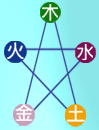
Traditional Chinese Medicine (TCM) and Seasonal Changes:
Transition to Autumn
By Aimee Brown, LAc, MSOM
The Yellow Emperor's Classic text states:
"Those who knew the way of keeping good health in ancient times always kept their behavior in daily life in accordance with nature. Their behaviors in daily life were all kept in regular patterns such as their food and drink were of fixed quantity; their daily activities were all in regular times. They never overworked. In this way, they could maintain both in the body and in the spirit substantiality, and were able to live to the old age of more than 100 years."
One of the major texts in regard to the understanding of Traditional Chinese Medicine speaks of the act of living life in accordance with nature in order to ensure optimal health. One such way would be to adapt one's daily life to the ever fluctuating seasons. As we approach autumn, we are looking at leaving behind the glowing warmth of summer as well as losing the natural availability of certain food items or crops. Autumn introduces the body to cooler temps and more sparse plant choices for nourishment. It is a time meant for preparing the body and one's life for the cold, scarcity of winter. We watch animals forage and store their wares for the winter and we humans must make the same preparations to keep our vitality up through the cold and darker days to come. At the beginning of Autumn, it is best to begin reducing cooling foods like cucumber and lettuces and introducing warm, cooked foods, such as root plants (beets, turnips, leeks, cabbage, squashes), pheasant, turkey and the like. Homemade soups or stews using warming spices are key. Using your local farmer's market is advisable in any season, as the foods nature produces in each season are at your fingertips.
Seasonal changes are an optimal time to re-visit your acupuncturist for some tune-up sessions. These treatments help bolster the immune system to avoid or lessen the effects of the shifts in temperature and onslaught of seasonal allergens. Acupuncture helps the body transition from hot to cold by adjusting the body's internal thermostat accordingly. One will also benefit from acupuncture's ability to strengthen the lungs, which are the body's first line of defense against colds and flus. With the impending dryness of the upcoming weather, it is also necessary to have the intestinal systems tuned up and detoxified to prevent sluggish bowels. Proper elimination is essential to maintain an energetic body and spirit. In accordance with honoring the spirit, this also tends to be a good time to purge any emotional heaviness; address and let go of personal burdens that might further bog you down during the winter months.
Acupuncture, one of Traditional Chinese Medicine�s most important modalities, is an integral tool in facilitating the inevitable shift encountered by body and spirit. By utilizing select acupuncture points, your practitioner is able to ease your body into making these shifts. Many people experience freedom from physical, as well as emotional burdens. Acupuncture causes the body to release endorphins, your body�s normal pain reliever or �feel good� chemical, in order to instill a feeling of lightness and peace. This can be especially helpful to those who may suffer from Seasonal Affective Disorder or �the winter blues�.
The natural support provided by Traditional Chinese Medicine is so important for those brought up in this culture. It has become a vital part of integrative medical practices throughout the country.
Aimee Brown, L.Ac, MSOM practices acupuncture at The Ommani Center for Integrative Medicine in Pewaukee, WI. She holds a state license in acupuncture and has a Master of Science in Oriental Medicine.
To schedule an appointment with Aimee, contact The Ommani Center at 262.695.5311. www.ommanicenter.com.
Andrew Weil, M.D., is a world-renowned leader and pioneer in the field of integrative medicine, a healing oriented approach to health care which encompasses body, mind, and spirit.
http://www.drweilblog.com/home/2010/5/20/all-about-acupuncture-part-1.html
http://www.drweilblog.com/home/2010/5/21/all-about-acupuncture-part-2.html
Acupuncture has been around for at least 2,500 years and has proven to be an effective method of both preventing and treating disease. If you've never experienced acupuncture, the following can help you to know what to expect.
- A skilled acupuncturist will first ask you questions about diet, exercise, stress levels and other physical and mental characteristics to get to know more about you and your health concerns.
- He or she may examine your tongue and take pulses on various parts of your body to determine the imbalances in energy flow
- Once this initial examination is completed, very fine needles will be gently placed in specific locations, just puncturing the skin. (The experience of being "needled" varies tremendously, but it's nothing to be afraid of. Some people don't feel the needles at all, while others have a sensation like a very small electric charge upon insertion.)
- Once the needles have been placed, they may be gently manipulated. Some practitioners may use heat or even very low voltage electricity with the needles.
- Needles are usually left in place for five to 20 minutes and typically no longer than 60 minutes, and then removed.
- Following a treatment, a practitioner will usually reassesses the client and often give suggestions for home care. He or she may also recommend supplemental Chinese herbs to help enhance and maintain the energetic balance achieved by the acupuncture session.
- The most common side effects of needling are bleeding and bruising at the insertion sites, along with minor pain and soreness. Those with bleeding disorders or who are taking blood thinners should check with their doctors before having acupuncture
Acute conditions may require only two to four sessions of acupuncture; for chronic cases, it is common to have as many as 12 or more treatments, usually over a course of eight to 10 weeks. Regular monthly visits may be suggested as a preventive measure to decrease stress, improve energy or boost immunity
What Health Concerns Can Acupuncture Best Help Address
Acupuncture is not just about needles, but is a comprehensive traditional therapy focused on correcting imbalances of energy flow throughout the body. It can be employed effectively for a wide variety of conditions:
- Emotional disorders such as anxiety, depression and post-traumatic stress disorder
- Digestive complaints, including nausea, vomiting, and irritable bowel syndrome
- Pain syndromes due to an injury or associated with chronic degenerative diseases such as rheumatoid arthritis
- Neurological problems like migraines or Parkinson's disease
- Respiratory conditions, including sinusitis and asthma
- Gynecologic disorders and infertility (it has demonstrated clinical success when used in conjunction with in-vitro fertilization)
- Fatigue or low energy
- Addictions
- Chronic lower back pain
It can also be used as a rehabilitation strategy for individuals who suffered a stroke, can help control chemotherapy-induced nausea and vomiting, and can help promote overall wellbeing.
If you are considering seeing an acupuncturist, you should discuss this therapy and seek a referral for a licensed acupuncturist from your primary care physician.
How Acupuncture May Work
The needles seem to boost levels of a natural pain-killing compound. Researchers at the University of Rochester in New York have reported that adenosine, an amino acid which becomes active in the skin to ease pain after an injury, also has activity in deeper tissues affected by acupuncture. In a study with mice, the investigators found that acupuncture reduced discomfort in a paw by two thirds in animals with normal, working levels of adenosine, but that needling didn�t work at all when the adenosine was inactivated. And when adenosine was "turned on" in tissues, discomfort faded even without acupuncture. During and immediately after acupuncture, adenosine levels in tissues near the needles were 24 times higher than they had been before treatment, the researchers reported. They also found that when they used a cancer drug, deoxycoformycin, which makes it harder for tissues to remove adenosine, the effects of acupuncture rose dramatically, nearly tripling the accumulation of adenosine in the muscles and more than tripling the length of time the treatment was effective. The study was published online May 30, 2010, in Nature Neuroscience.
How About This for Natural Healing and Stress Reduction?
For more information on Acupuncture or to request an appointment - Call 414.416.3278 for a consultation today in Oconomowoc